

The Disappearing Act: With a slight of AI hand, Google removed much small and midsize business website traffic in a few weeks. Most websites did not recover. Read our tips and consider reaching out to recover your traffic.
We monitor and report monthly website measurements for many small and midsize businesses (SMBs). This allows us to:
- Course-correct
- Respond proactively to shifts
- Measure the results of our efforts
Something pretty drastic happened across the board last year, and we decided to take a closer look for ourselves.
What We Studied and Definitions
In this study, we reviewed one year of Google Search results data for 19 SMB websites (some clients, some not).
Here’s what we measured:
- Impressions: how frequently a website was shown to “Googlers” on a search results page.
- Clicks: when a potential website visitor saw a result, how often they clicked on it.
- CTR: click-through rate, i.e., the number of clicks divided by the number of impressions.
- Average Search Position: how far down the search results page the website was listed compared to other unpaid search results.
Here’s what we found for these SMBs.
The “Why” Behind Our SMB Research
Although AI Overviews officially launched in the United States on May 15, 2024, their effects hit SMB (small and midsize business) websites in August 2025, along with an August 2025 spam update that rolled out for 26 days across August and September 2025.
Data has been widely reported for enterprise companies, but less frequently for the impact on SMBs. For this reason, we conducted this analysis.
Disappearing Act: The Search Impressions Plunge
One year ago, we saw a significant change across client and nonclient websites. As the six graphs below demonstrate, Google impressions (i.e., the number of times a website appeared in search results) fell dramatically. (See six examples in the figures below)
We wanted to know if the websites recovered from this drop. The answer is "no."
On average, websites saw an almost 50% year-over-year drop in impressions while the median fell 28.8%.
Search impressions nearly disappeared for many SMBs. This means their websites were shown less frequently in the search results pages.
6 Examples of Impressions Patterns for SMB Websites
These six websites demonstrated different impression patterns, but all showed drops in impressions from July to November.
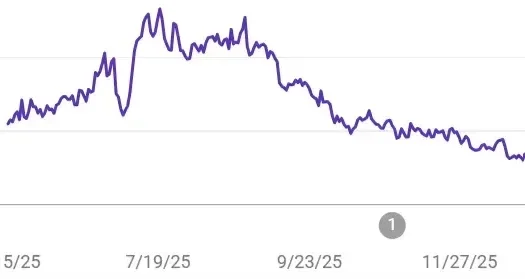
Search impressions for this midsize business gradually slid down hill.
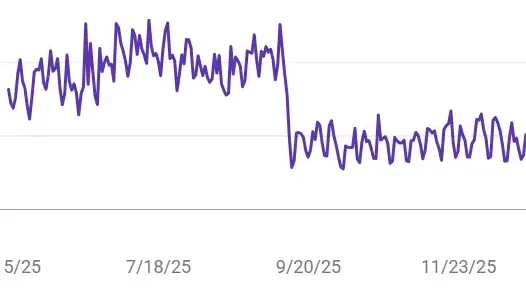
Search impressions took a steep plunge for this small business.
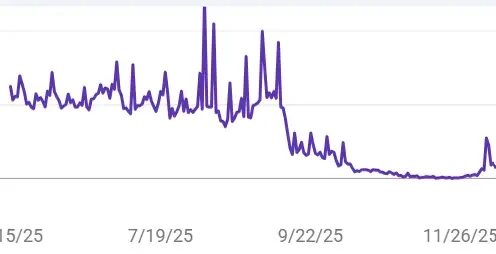
For this small business, search impressions also fell sharply.
Search impressions not only fell for this business, but they also became nearly nonexistent.
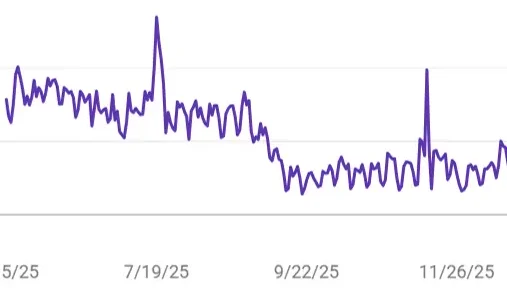
Search impressions bounced into the basement for this SMB.
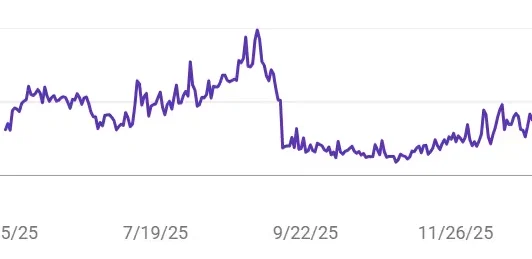
For this midsize business, search impressions did a nose dive, but then recovered slightly.
Our SEO Insight
Google considers search impressions a ranking factor in of itself. This means a drop in how often Google shows a website also affects how often it will be shown in the future.
Yes, that is almost circular logic.
Variable Click Reductions
People can only click on website search results that they see. In other words, to get a click to your website, it must first be shown (an impression) so it can be clicked.
No impression, no click.
No click means no search traffic to your website. No traffic means no new leads or customers from search.
We wanted to know whether the drop in impressions impacted the number of clicks or if websites recovered over the year.
Our research showed significant variability in clicks. While the average number of clicks decreased by 9.5% year over year, the median actually increased by 21.5%.
This is because 9 of the 19 websites received more clicks than they did before.
See boxed content: 10 Reasons Some Websites Got MORE Clicks or IMPROVED CTRs
Representative Click Trends for SMB Websites
These four websites show the variability in click patterns across different SMB websites during the same period from May 2025 to September 2026--the longest possible span (16 months) for which Google Search Console retains the data.
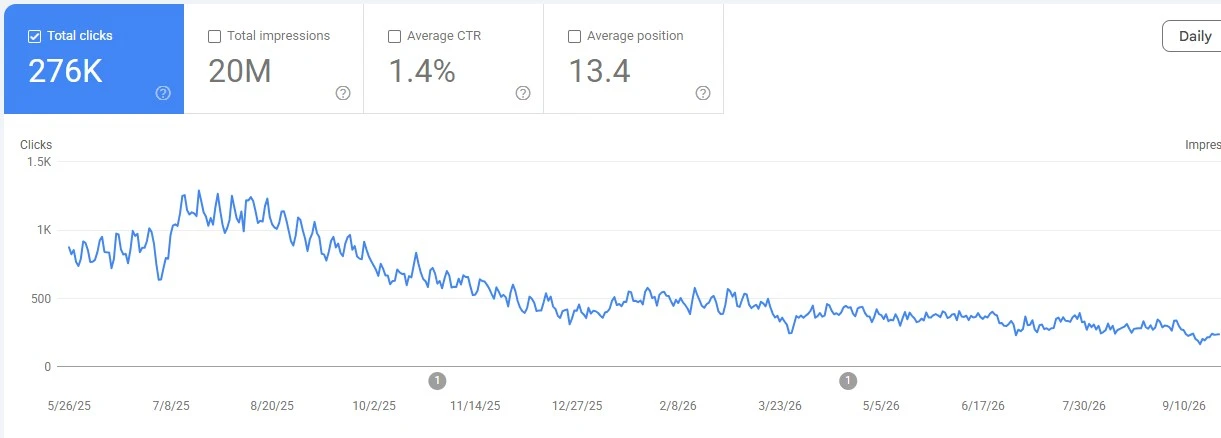
This midsize business, which enjoyed a total of 276,000 clicks for the one-year span, never recovered from the spam update, AI Overviews, and the concomitant decrease in impressions.
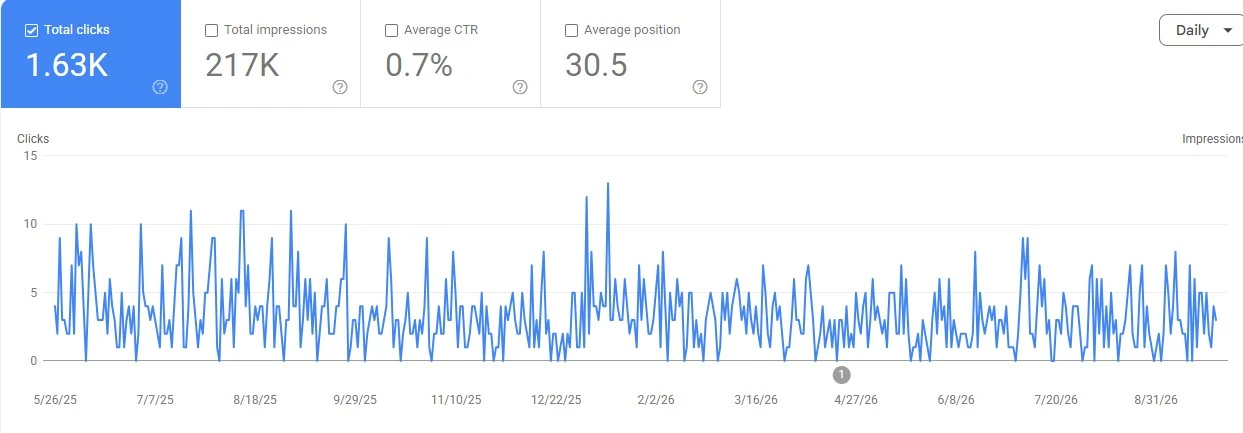
This small business continued to get clicks, but its peak number of clicks per day never fully recovered.
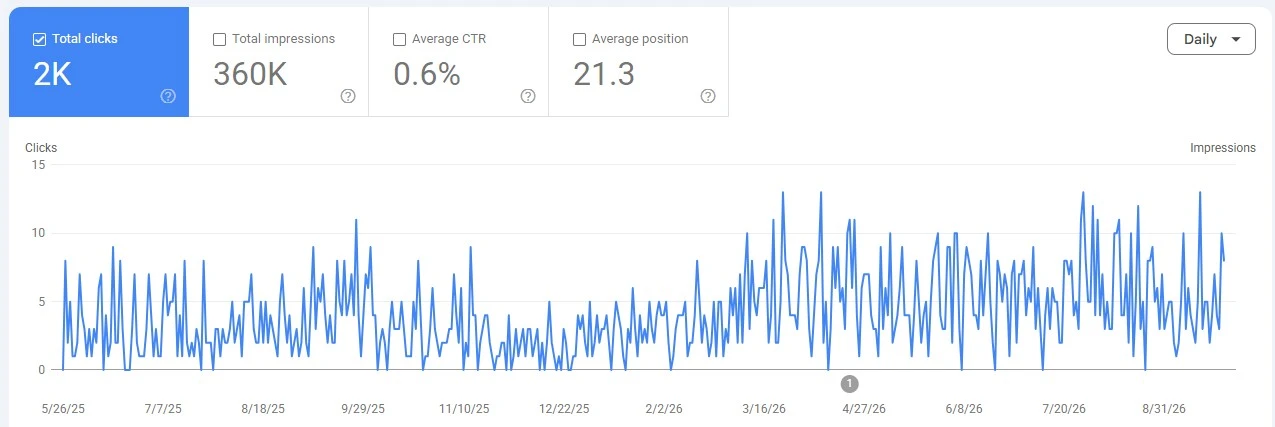
This small business began to get more clicks and, at times, its daily clicks were higher.
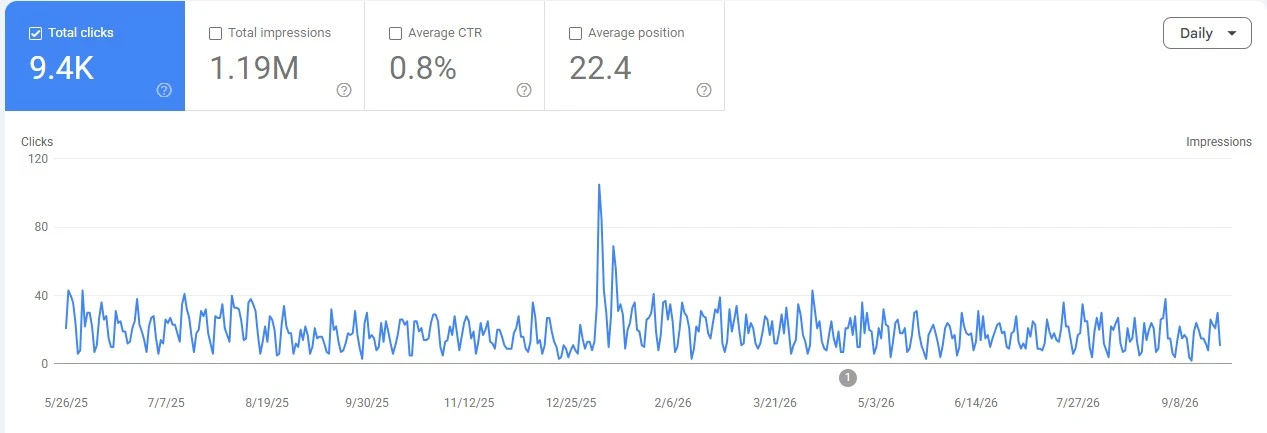
This small to midsize business continued to get clicks at almost an identical pace.
The Down Shift…Or Not: Click-through Rates
The average CTRs DECREASED slightly (2%).
In contrast, the median CTR INCREASED 30%. In fact, 12 of the 19 websites had higher CTRs.
Why might this be? See boxed content: 6 Reasons Some Websites Got MORE Clicks or IMPROVED CTRs
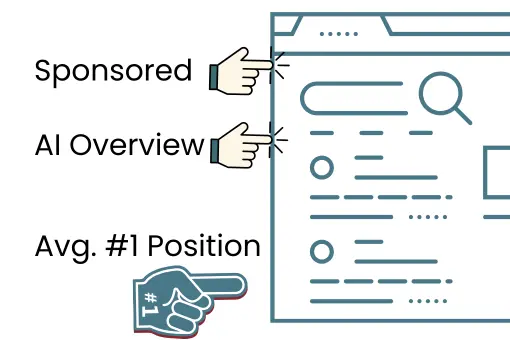
Your average search position may look like it improved (decreased) dramatically. But it's important to keep in mind that the "first" search position is almost never at the top of the Google results page.
A Trick “Improvement:” Average Search Position
The closer a relevant search result appears to the top of a page, the more clicks it gets and the higher its click-through rate. This advantage is now rare.
Although we saw an improvement (lower number) in the average search result position, the AI Overviews and Search Ads typically dominate today’s search results page. They push the first search result down.
Now, the average first-position number is closer to 1, but that first position is much lower on the page. Therefore, a true position “one” is rare—let alone a third- or fourth-position result.
Our SEO Insights
Too often, we see clients who have structured or want to structure their website content from an internal company point of view.
Instead, step out of your own way. Use the language your customers will use to "Google" your content. Don't miss opportunities by using nonstandard abbreviations or industry jargon—or viewing your products or services in ways that customers don’t.
For example, do your products meet certain specifications? Or could they be used in ways that you hadn't considered? We believe relevant keyword research is still useful. It can give you a broad sense of customers’ interests.
The goal isn’t to choose the top-volume search. It's rarely the one you want. Nor is the purpose to stuff your content with keywords.
Conclusion
Navigating the shifting sands of search and search engine optimization (SEO) can feel unpredictable, but these results prove one fundamental truth: sustainable success belongs to businesses that focus on quality, intent, and integrity. While shortcuts and spammy tactics may offer temporary gains, they ultimately leave websites vulnerable to algorithm shifts.
By focusing on what you can control—writing specific, high-intent content, building a strong brand, maintaining clean technical practices, and putting your audience first—you make your website naturally resilient. The search algorithms will keep changing, but a commitment to genuine expertise and helpfulness will always win the click.
If you don't know what to do next, our agency can help you.
10 Reasons Some Websites Got MORE Clicks and/or IMPROVED CTRs
We propose 10 reasons why some websites received more clicks or improved CTRs while other SMB results fell across the board. See how you can get more relevant clicks, too.
High-Intent Searchers
First, some searchers know what they want and keep searching until they find it, so that a website may get a click even with fewer impressions. These super-determined searchers are considered high-intent visitors. Your content met their need in a way others’ did not.
Expert Tip: Know what your customers want. ASK them, and pay attention to what they ask you.
Greater Brand Power
Brand name searches are less likely to be shown in Google’s AI Overviews. As a result, these branded searches retain impressions. Companies with stronger brand recognition see higher CTRs.
You can learn more about branding on our branding service page and by reading our branding articles.
Expert Tip: Build a strong brand both visually and verbally.
You Got Opinionated...But Avoided Superlatives
Add your thoughts; don't just serve up the usual and expected.
At the same time, don't exaggerate.
Wrote Compelling Meta Descriptions
Although search engines often rewrite meta descriptions, a well-written meta description acts like advertising copy. Websites with compelling meta descriptions get more clicks and higher CTRs, even with fewer impressions. These visitors qualify themselves.
What You Wrote Was Worth Reading
If your page content is more engaging, visitors will stay longer--and they won't “re-Google” for a more satisfying answer.
It's even better if your content is worth bookmarking or returning to again. This signals to machine-learning robots (aka AI) an indication that the content is good.
You Got Specific About Who, Why, & How
Websites with broad, high-volume search terms were likely to lose traffic. This is because AI Overviews provided the answer they were looking for.
This is especially true of “what is…?” searches.
Therefore, pages with more specific, detailed content would get more clicks. In other words, the content was more specific, relevant, and therefore exactly what that searcher wanted. Marketers call these long-tail searches because they mimic the long tail on a bell curve rather than the high-volume middle.
You don't need the greatest volume of traffic; you need relevant traffic that can become potential clients or customers.
Unique and Helpful Content
Google doesn’t like messy, fake, or copied pages. It doesn’t reward low-effort, generic, or AI-churned copy. It reports that it removed the junk and kept only the most helpful information that showcased experience, expertise, authoritativeness, and trustworthiness (E-E-A-T).
In other words, those websites had more helpful, unique content written by humans—not generated by AI or scraped from someone else’s website.
Read Google's recently updated "Creating helpful, reliable, people-first content."
Well-Structured Pages
Some websites don’t structure their pages well. Websites that use clear headings, logical content chunks, bullet points, and tables get more clicks and higher CTRs because they help both humans and robots follow the page content. Ensure that your main content is clearly defined.
Used Spam-free SEO Practices
Google has long warned against spammy SEO practices. But many websites tried to “game” the SEO system anyway. Spammy practices include:
- Link spam (having inappropriate sites linking to yours)
- Buying links rather than getting them naturally
- Scraping content (duplicating content from another site)
- Hidden text or links (hiding links with white text or similar)
- Keyword stuffing (over-using synonyms for the topic of the page)
If a website has always avoided these practices, it fared better.
Something Else Entirely
Another reason some websites increased traffic had to do with factors beyond SEO. Maybe they launched a new product, held a popular contest, planned an event, or expanded in the second year in a way that they did not in year one.
The Search Data
We calculated the mean and median of four standard search metrics to assess organic search status 1 year after the major Google changes.
From July 2025 to July 2026, average monthly impressions fell by almost half. However the median impressions fell 29%.
| IMPRESSIONS | JULY 2025 | JULY 2026 | CHANGE |
| Mean | 42,333 | 21,463 | -49.3% |
| Median | 16,300 | 11,600 | -29% |
From July 2025 to July 2026, average monthly clicks for July decreased by nearly 10%. However the median monthly clicks grew 21.5%.
| CLICKS | JULY 2025 | JULY 2026 | CHANGE |
| Mean | 658 | 596 | -9.5% |
| Median | 135 | 164 | 21.5% |
Average percent click-through rates (CTRs) decreased slightly, but hovered around 2% for small and mid-size businesses. The median for these SMBs was closer to 1% but grew approximately 30%.
| CTRs | JULY 2025 | JULY 2026 | CHANGE |
| Mean | 2.03% | 1.98% | -2.1% |
| Median | 1.0% | 1.3% | 30% |
From July 2025 to July 2026, average national search position for these websites was position 28--in other words on approximately the third page.
After the updates, it improved nearly 52% to an average position of 13. The median also improved from 30 to 12, a 59% improvement.
| AVG POSITION | JULY 2025 | JULY 2026 | IMPROVEMENT |
| Mean | 28 | 13 | 52% |
| Median | 30 | 12 | 59% |
Source:
This original content was written by a human, Nancy (Stearns) Burgess, and is based on our real experience with SMBs. We wrote it to address trends we are seeing in marketing and the search industry. We then asked Gemini for a fact check and a commodity check. We tweaked a few typos, and Gemini approved our content.
Nancy has been generating online content and following organic search practices since the dawn of websites. Her writing in print publications pre-dates the public availability of the internet.
Nancy Burgess
Nancy Burgess is the owner of Nancy Burgess Strategic Marketing, a marketing consulting firm and online agency. In that role, she integrates her corporate success as a digital marketer along with her marketing agency experience in marketing communications and branding to help businesses prosper.
Nancy's specialties are search engine optimization (SEO) and content creation.
She graduated from the University of Illinois in Champaign-Urbana, holds a master's degree, and also multiple marketing certificates from DePaul University's graduate school.
She is a frequent presenter on SEO strategies and has worked in digital marketing since the late 1990s.
As someone who can strategize AND execute, Nancy offers digital and traditional marketing services to SMBs. Agency value without agency fees.
Along with SEO and content strategies, Nancy's agency offers website design, marketing automation, integrated marketing strategies, and branding to her clients.
